
How to Prepare for Your First Job Interview
How to Prepare for Your First Job Interview
Learn how to prepare for your first job interview with practical tips, common interview questions, resume advice, interview etiquette, and confidence-building strategies for students and freshers.
Focus Keyword: How to Prepare for Your First Job Interview
—
How to Prepare for Your First Job Interview
Your first job interview is an exciting milestone. It marks the beginning of your professional journey and gives you an opportunity to showcase your skills, personality, and potential.
It’s completely normal to feel nervous before an interview. Most freshers worry about questions like:
– What should I wear?
– What questions will be asked?
– How do I answer confidently?
– What if I don’t know an answer?
– How can I impress the interviewer?
The good news is that interview success isn’t just about having the perfect answers—it’s about preparation, confidence, communication, and a positive attitude.
This guide will help students and freshers prepare effectively for their first job interview.
—
Why Interview Preparation Matters
A job interview allows employers to evaluate more than your qualifications.
They want to understand:
– Your communication skills
– Problem-solving ability
– Confidence
– Attitude
– Professionalism
– Willingness to learn
– Cultural fit
Good preparation helps you present yourself clearly and confidently.
—
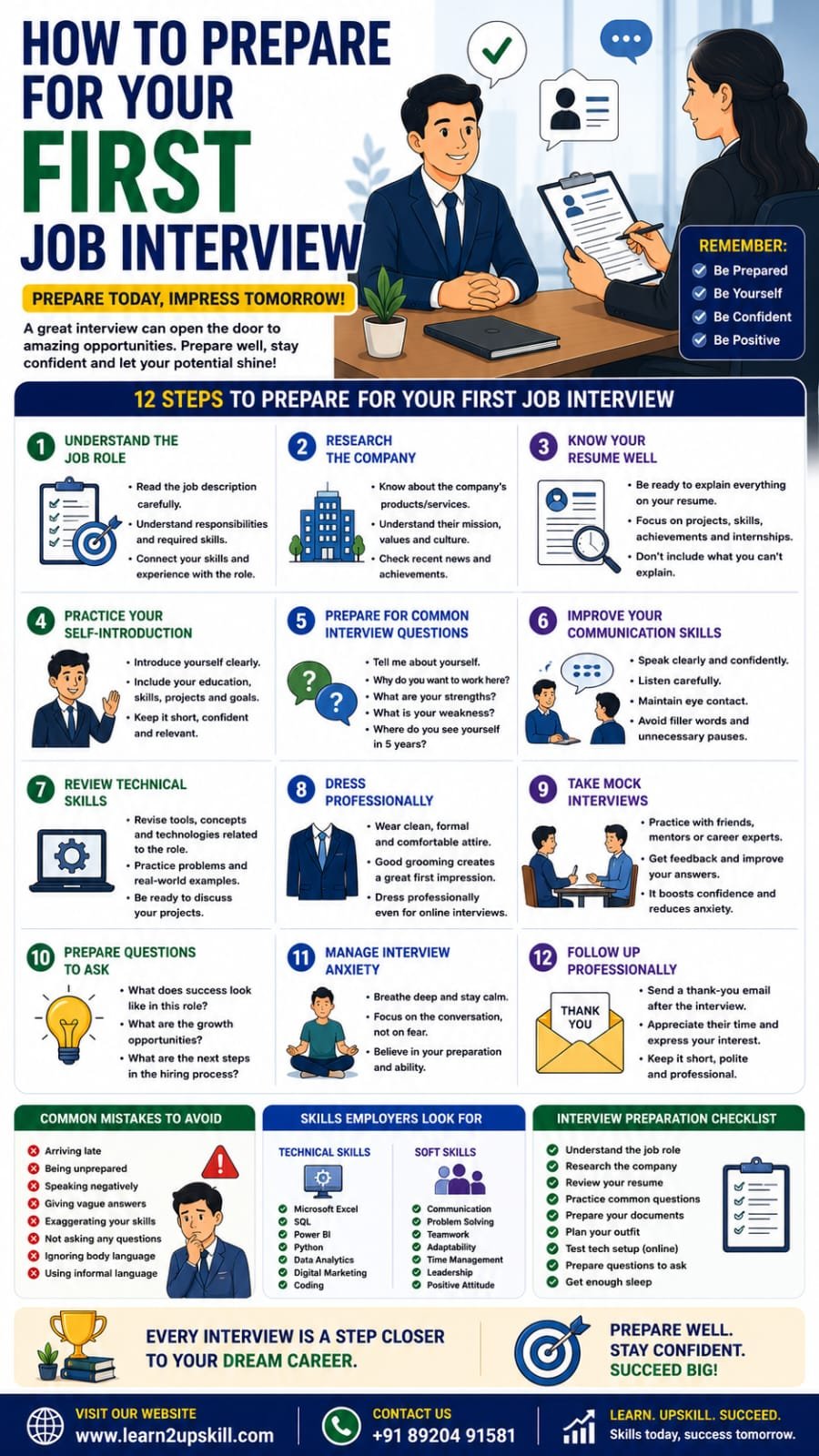
Step 1: Understand the Job Role
Before attending any interview:
– Read the job description carefully.
– Understand the required skills.
– Research the responsibilities.
– Identify how your education and projects relate to the role.
Tailoring your preparation to the specific position makes a strong impression.
—
Step 2: Research the Company
Employers appreciate candidates who understand their organization.
Learn about:
– Company products or services
– Mission and values
– Industry
– Recent achievements
– Company culture
Review the company’s website and professional social media profiles to gain a better understanding of its work.
—
Step 3: Know Your Resume Thoroughly
Everything listed on your resume is fair game for discussion.
Be ready to explain:
– Education
– Certifications
– Projects
– Internships
– Technical skills
– Achievements
– Extracurricular activities
Never include skills or experiences you cannot confidently discuss.
—
Step 4: Practice Your Self-Introduction
One of the first questions is often:
“Tell me about yourself.”
A good introduction should include:
– Your name
– Educational background
– Relevant skills
– Academic or personal projects
– Career interests
– Why you’re excited about the opportunity
Keep your introduction clear, concise, and focused on the role.
—
Step 5: Prepare for Common Interview Questions
Some frequently asked questions include:
Tell me about yourself.
Why do you want to work here?
What are your strengths?
What is one area you are working to improve?
Why should we hire you?
Describe a challenge you overcame.
Where do you see yourself in five years?
Tell us about a project you worked on.
Practice your responses, but avoid memorizing them word for word.
—
Step 6: Improve Communication Skills
Interviewers value candidates who communicate clearly.
Practice:
– Speaking confidently
– Maintaining eye contact (for in-person interviews)
– Listening carefully
– Answering concisely
– Asking thoughtful questions
Strong communication leaves a lasting impression.
—
Step 7: Review Technical Skills
Depending on the role, refresh your knowledge of relevant tools and concepts.
Examples include:
Data Analytics
Digital Marketing
Review projects where you’ve applied these skills.
—
Step 8: Dress Professionally
Your appearance contributes to the first impression.
Choose:
– Clean, professional clothing
– Comfortable footwear
– Minimal accessories
– Neat grooming
Even for virtual interviews, dress professionally from head to toe—it can help you feel more confident.
—
Step 9: Practice Mock Interviews
Conduct practice interviews with:
– Friends
– Family members
– Mentors
– Career counselors
Mock interviews help you:
– Improve confidence
– Identify weak areas
– Refine answers
– Receive constructive feedback
—
Step 10: Prepare Questions for the Interviewer
At the end of many interviews, you’ll be asked:
“Do you have any questions for us?”
Consider asking:
– What does success look like in this role?
– What learning opportunities are available?
– What does the onboarding process involve?
– How does the team collaborate?
Thoughtful questions demonstrate genuine interest.
—
Step 11: Manage Interview Anxiety
Feeling nervous is normal.
Try these strategies:
– Prepare thoroughly.
– Practice deep breathing before the interview.
– Arrive early or log in ahead of time.
– Focus on sharing your knowledge rather than being perfect.
– Remember that the interview is also your chance to evaluate the company.
Confidence grows with preparation.
—
Step 12: Follow Up Professionally
After the interview, send a polite thank-you email if appropriate.
Express appreciation for the interviewer’s time and reaffirm your interest in the role.
A professional follow-up can leave a positive impression.
—
Common Interview Mistakes to Avoid
Avoid these common mistakes:
– Arriving late
– Speaking negatively about previous employers or teachers
– Interrupting the interviewer
– Giving vague answers
– Exaggerating your skills
– Forgetting to research the company
– Ignoring body language
– Not asking any questions
– Using informal language in a professional setting
—
Skills Employers Look For
Employers value candidates who demonstrate:
Technical Skills
Soft Skills
These qualities often make a strong impression, even for entry-level roles.
—
Virtual Interview Tips
Many first interviews now take place online.
Before the interview:
– Test your internet connection.
– Check your camera and microphone.
– Choose a quiet, well-lit location.
– Close unnecessary applications.
– Keep your resume and notes nearby.
– Maintain eye contact by looking at the camera when speaking.
—
Interview Preparation Checklist
Before your interview, make sure you have:
– Reviewed the job description
– Researched the company
– Practiced common questions
– Updated your resume
– Prepared your documents
– Planned your outfit
– Tested your technology (for online interviews)
– Prepared thoughtful questions
– Gotten enough sleep the night before
—
Frequently Asked Questions (FAQs)
How long should I prepare for my first interview?
Ideally, begin preparing several days in advance. Focus on understanding the role, researching the company, reviewing your resume, and practicing interview questions.
What if I don’t know the answer to a question?
Stay calm and honest. Explain your thought process or related knowledge instead of guessing or pretending to know something you don’t.
Is confidence more important than technical knowledge?
Both matter. Employers often look for candidates who combine relevant skills with a positive attitude, communication abilities, and a willingness to learn.
Should freshers ask questions during the interview?
Yes. Asking thoughtful questions about the role, team, or learning opportunities shows genuine interest and engagement.
—
Final Thoughts
Your first interview is not about being perfect—it’s about showing your potential. Employers understand that freshers are still learning. They value candidates who are prepared, curious, professional, and eager to grow.
With consistent preparation, practice, and confidence, you can make a strong impression and increase your chances of landing your first job.
Remember, every interview is also a learning experience. Even if one opportunity doesn’t work out, the experience will help you perform better in the next one.
At Learn2Upskill, we help students and freshers become job-ready through practical training, career guidance, interview preparation, and industry-focused courses in Microsoft Excel, Power BI, Python, Data Analytics, Artificial Intelligence, Digital Marketing, and more.
Visit: www.learn2upskill.com
Contact Us: +91 89204 91581
Prepare with Confidence. Interview with Impact. Start Your Career with Learn2Upskill.
You May Also Like
The Complete Guide to Building Confidence and Success Introduction In today’s competitive world, academic knowledge alone is not enough to...
-
-
July 31, 2026
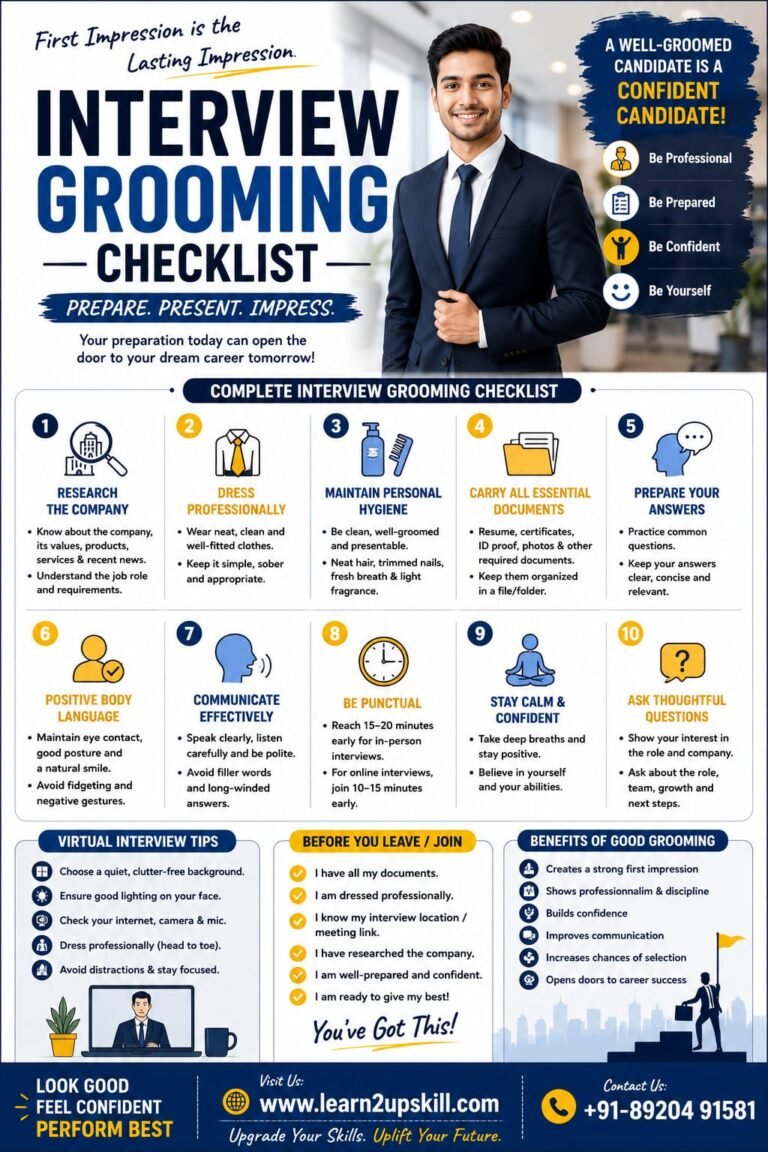
Interview Grooming Checklist Introduction Your interview begins long before you answer the first question. From the moment you enter the...
-
-
July 31, 2026
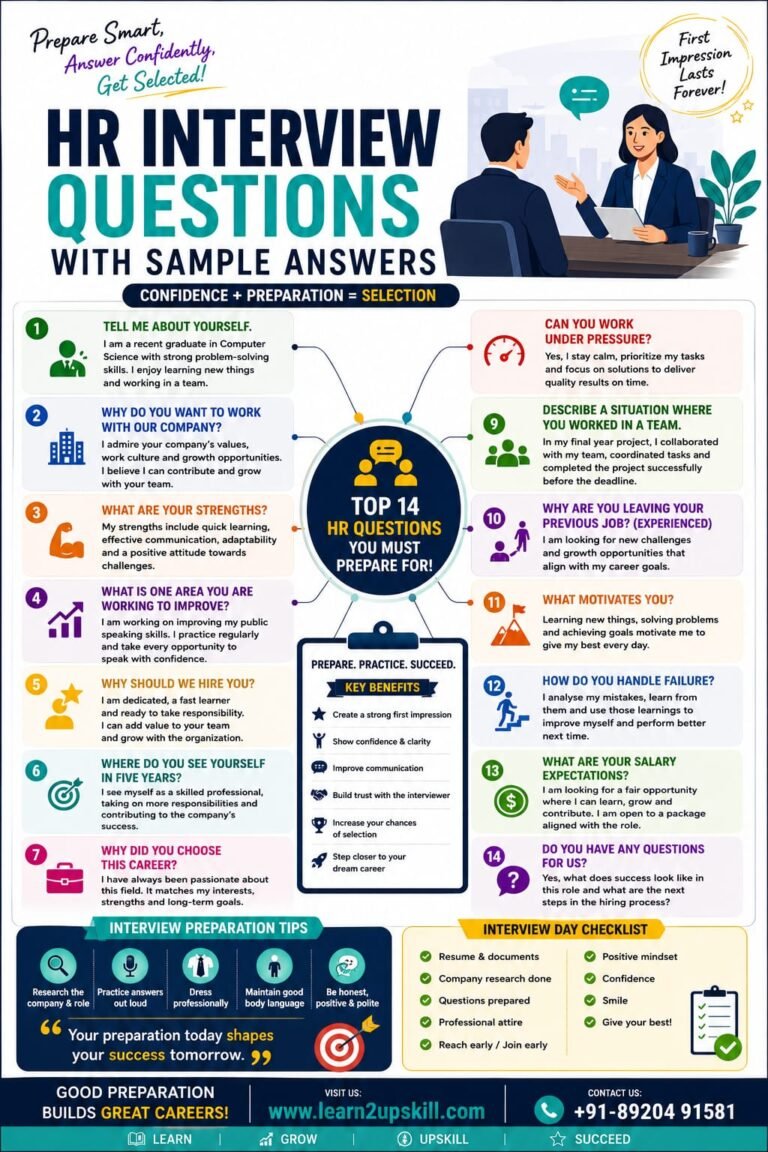
Top HR Interview Questions with Sample Answers Introduction An HR interview is often the final step in the hiring process...
-
-
July 30, 2026