

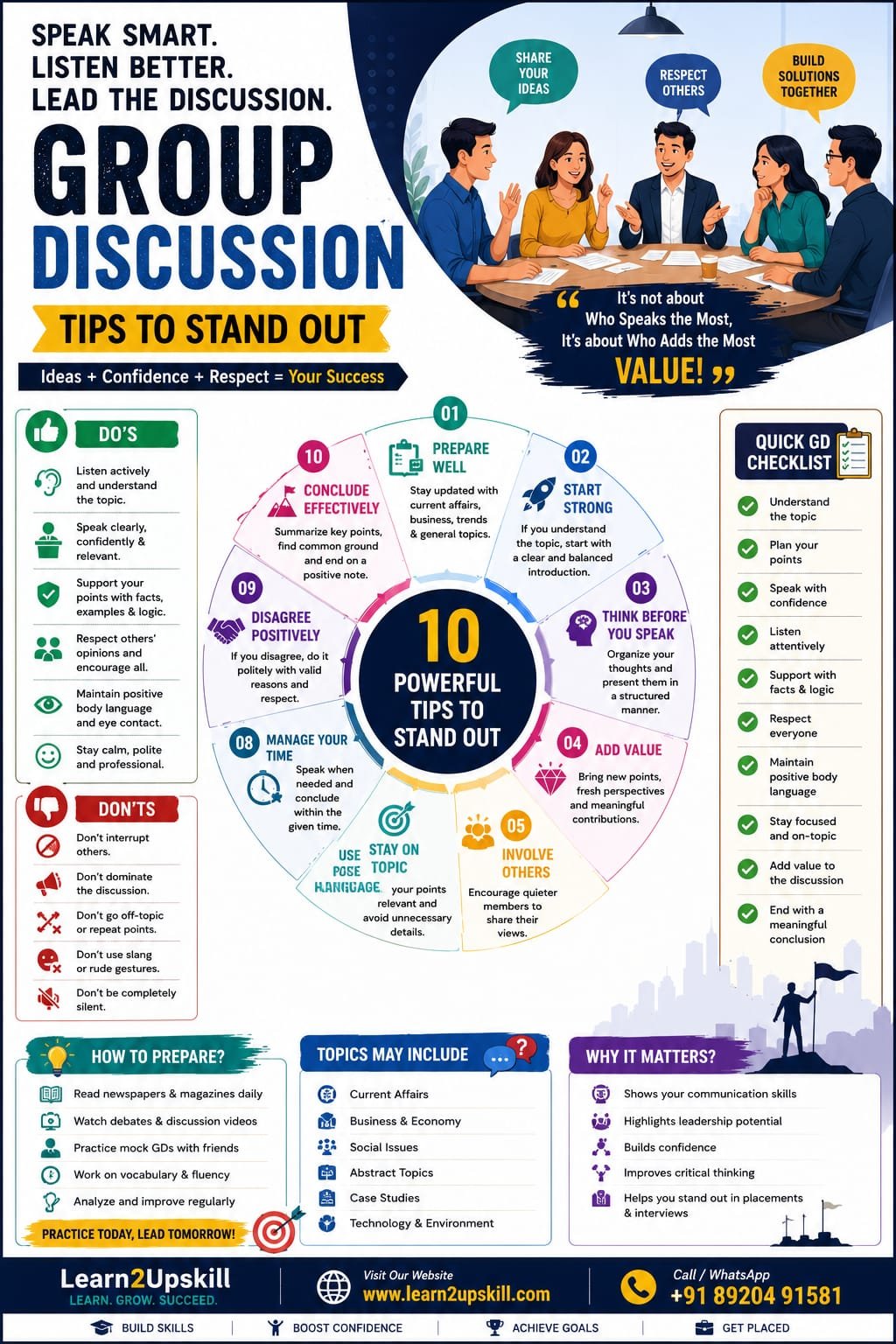
Group Discussion Tips to Stand Out
Group Discussion Tips to Stand Out
Introduction
Group Discussions (GDs) are a common part of campus placements, job interviews, management admissions, and scholarship selection processes. They help recruiters evaluate not only your knowledge but also your communication skills, confidence, leadership, teamwork, and problem-solving ability.
Many candidates lose confidence because they think they must speak the most to impress the panel. In reality, recruiters look for candidates who communicate clearly, listen actively, present logical ideas, and contribute positively to the discussion.
With the right preparation and approach, you can confidently stand out in any Group Discussion.
At Learn2Upskill, we help students and job seekers build the confidence, communication skills, and professional attitude needed to excel in Group Discussions and interviews.
—
What Is a Group Discussion?
A Group Discussion is a structured conversation where a group of candidates discusses a given topic within a limited time. The purpose is to assess how participants think, communicate, collaborate, and handle different opinions.
The discussion may be based on current affairs, business topics, social issues, abstract ideas, or case studies.
—
Why Are Group Discussions Important?
Recruiters use Group Discussions to evaluate:
– Communication skills
– Leadership qualities
– Confidence
– Teamwork
– Listening ability
– Critical thinking
– Problem-solving skills
– Creativity
– Decision-making
– Professional attitude
A strong GD performance often increases your chances of advancing to the interview stage.
—
Qualities Recruiters Look For
During a Group Discussion, employers observe whether you:
– Speak confidently.
– Present logical ideas.
– Listen to others respectfully.
– Support your opinions with examples.
– Encourage teamwork.
– Stay calm under pressure.
– Respect different viewpoints.
– Avoid unnecessary arguments.
– Demonstrate leadership.
– Manage time effectively.
Remember, it is about contributing meaningfully—not dominating the discussion.
—
Types of Group Discussion Topics
You may encounter topics such as:
Current Affairs
Examples:
– Artificial Intelligence in Education
– Climate Change
– Digital India
– Social Media and Society
Business Topics
– Startup Culture
– Remote Work
– Digital Marketing
– E-commerce Growth
Abstract Topics
– Success
– Time Is Money
– Blue Is Better Than Green
Case Studies
Candidates analyze a business or real-life problem and suggest solutions.
Preparing for different topic types improves your confidence.
—
How to Prepare Before a Group Discussion
- Stay Updated
Read newspapers, business magazines, and trusted news websites regularly. Understanding current events helps you contribute with relevant examples.
—
- Improve Communication Skills
Practice speaking clearly and confidently.
Regular practice makes communication more natural.
—
- Practice with Friends
Join mock Group Discussions with classmates or mentors.
Practice is one of the best ways to reduce nervousness.
—
- Organize Your Thoughts
Before speaking:
– Understand the topic.
– Think about key points.
– Arrange ideas logically.
– Support your opinion with examples.
Structured responses are easier to understand.
—
Tips to Stand Out in a Group Discussion
- Start the Discussion (If You Can)
If you understand the topic well, begin the discussion with a clear and balanced introduction.
Starting confidently can create a positive first impression, but only if you have something meaningful to say.
—
- Listen Carefully
Do not focus only on speaking.
Listen actively to:
– Understand others’ viewpoints.
– Build on good ideas.
– Avoid repeating points.
Good listeners often become better speakers.
—
- Speak Clearly and Confidently
Maintain:
– Moderate speed
– Clear pronunciation
– Confident tone
– Professional language
Avoid speaking too softly or too quickly.
—
- Support Your Arguments
Use:
– Facts
– Statistics (when accurate)
– Real-life examples
– Logical reasoning
Strong arguments make your opinions more convincing.
—
- Respect Different Opinions
Even if you disagree:
– Stay polite.
– Avoid personal attacks.
– Focus on ideas, not individuals.
Professional behavior leaves a lasting impression.
—
- Encourage Team Participation
Leadership is not about speaking the most.
Invite quieter participants by saying things like:
«”I’d like to hear another perspective on this.”»
This shows maturity and teamwork.
—
- Maintain Positive Body Language
Good body language includes:
– Eye contact
– Upright posture
– Natural hand gestures
– Smiling when appropriate
– Calm facial expressions
Positive body language reflects confidence.
—
- Avoid Interrupting Others
Wait for the right moment before speaking.
Interrupting repeatedly creates a negative impression.
—
- Stay Relevant
Speak only about the topic.
Avoid unnecessary stories or unrelated information.
Quality matters more than quantity.
—
- Conclude Effectively
If given the opportunity, summarize the discussion by highlighting the key points and common conclusions without introducing new arguments.
A good conclusion demonstrates leadership and clarity.
—
Common Group Discussion Mistakes
Avoid these common mistakes:
– Speaking without understanding the topic
– Interrupting others
– Dominating the discussion
– Remaining completely silent
– Speaking too fast
– Giving incorrect facts confidently
– Using disrespectful language
– Poor eye contact
– Negative body language
– Arguing aggressively
Avoiding these habits significantly improves your GD performance.
—
Body Language Tips
During the discussion:
– Sit upright.
– Maintain eye contact with different participants.
– Smile naturally.
– Keep your hands relaxed.
– Avoid fidgeting.
– Show interest while others speak.
Confident body language enhances your overall personality.
—
Daily Practice Routine
To improve your Group Discussion skills:
– Read news for 20 minutes daily.
– Watch discussions and debates.
– Learn five new words every day.
– Practice speaking in front of a mirror.
– Join mock Group Discussions.
– Record yourself and review your performance.
– Work on pronunciation and clarity.
Consistency leads to confidence.
—
Skills You Develop Through Group Discussions
Participating regularly improves:
– Communication skills
– Leadership
– Critical thinking
– Teamwork
– Confidence
– Decision-making
– Public speaking
– Emotional intelligence
– Professional etiquette
These skills are valuable throughout your career.
—
Final Checklist Before a Group Discussion
Before entering the discussion, remember to:
– ✔ Understand the topic carefully.
– ✔ Stay calm and confident.
– ✔ Listen actively.
– ✔ Speak with clarity.
– ✔ Respect everyone.
– ✔ Support your ideas with logic.
– ✔ Maintain positive body language.
– ✔ Stay focused on the topic.
Small habits can make a big difference.
—
Conclusion
A successful Group Discussion is not about speaking the loudest—it is about communicating effectively, thinking logically, listening respectfully, and working collaboratively. With regular practice, current affairs knowledge, and strong communication skills, you can confidently stand out and make a lasting impression on recruiters.
Every Group Discussion is an opportunity to demonstrate your personality, leadership, and professionalism. Prepare well, believe in yourself, and let your ideas speak with confidence.
At Learn2Upskill, we help students and job seekers build communication skills, personality development, interview preparation, career readiness, and leadership abilities to achieve success in placements and professional careers.
—
Contact Learn2Upskill
Website: www.learn2upskill.com
Contact Us: +91-89204 91581
Learn2Upskill – Learn. Grow. Succeed.
You May Also Like
The Complete Guide to Building Confidence and Success Introduction In today’s competitive world, academic knowledge alone is not enough to...
-
-
July 31, 2026
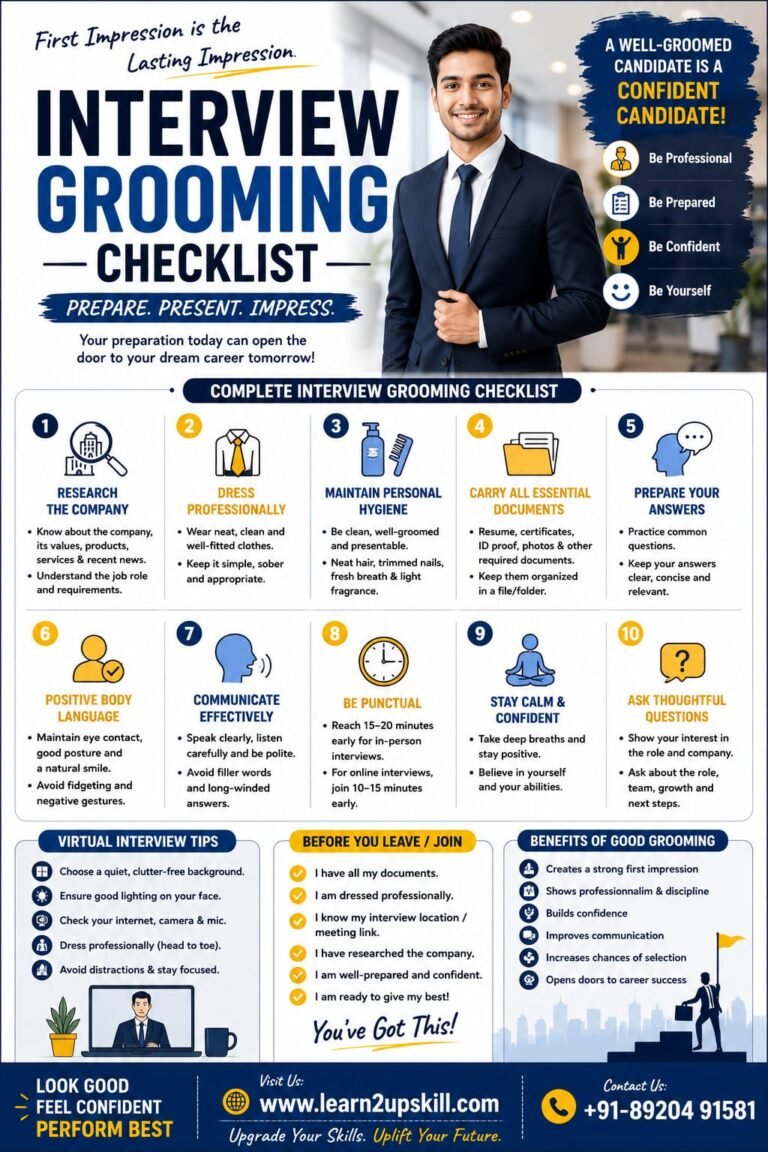
Interview Grooming Checklist Introduction Your interview begins long before you answer the first question. From the moment you enter the...
-
-
July 31, 2026
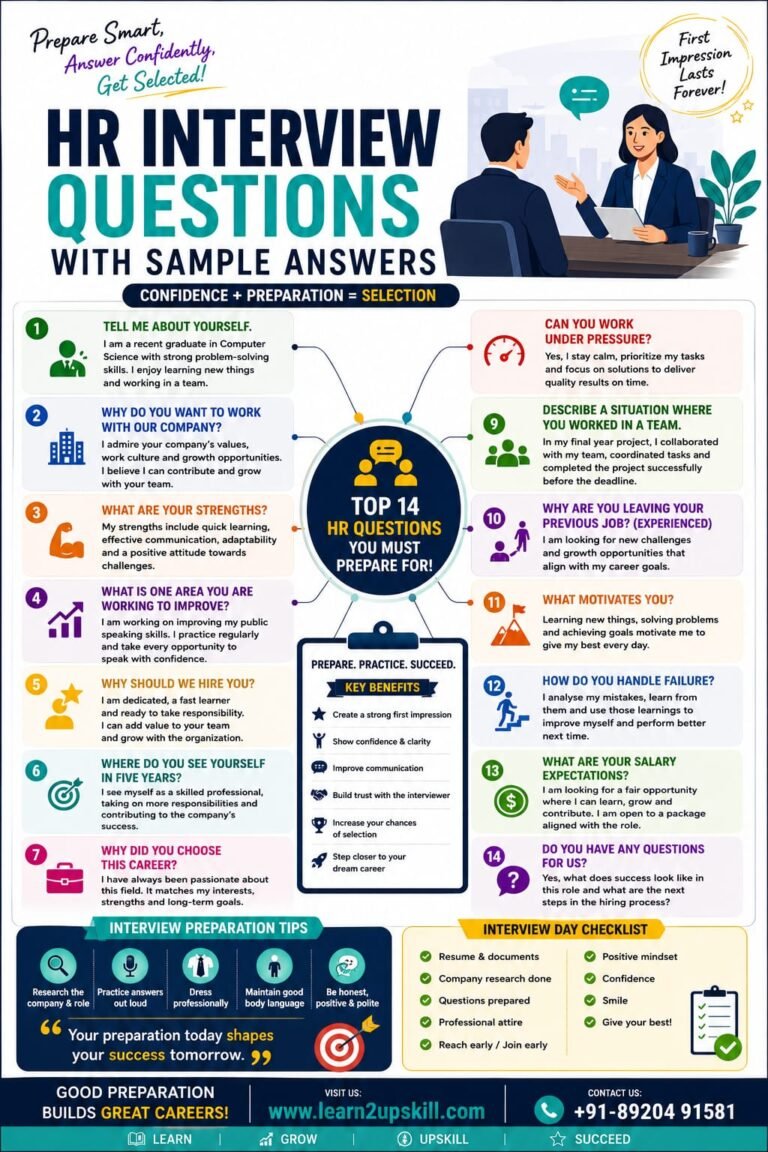
Top HR Interview Questions with Sample Answers Introduction An HR interview is often the final step in the hiring process...
-
-
July 30, 2026