

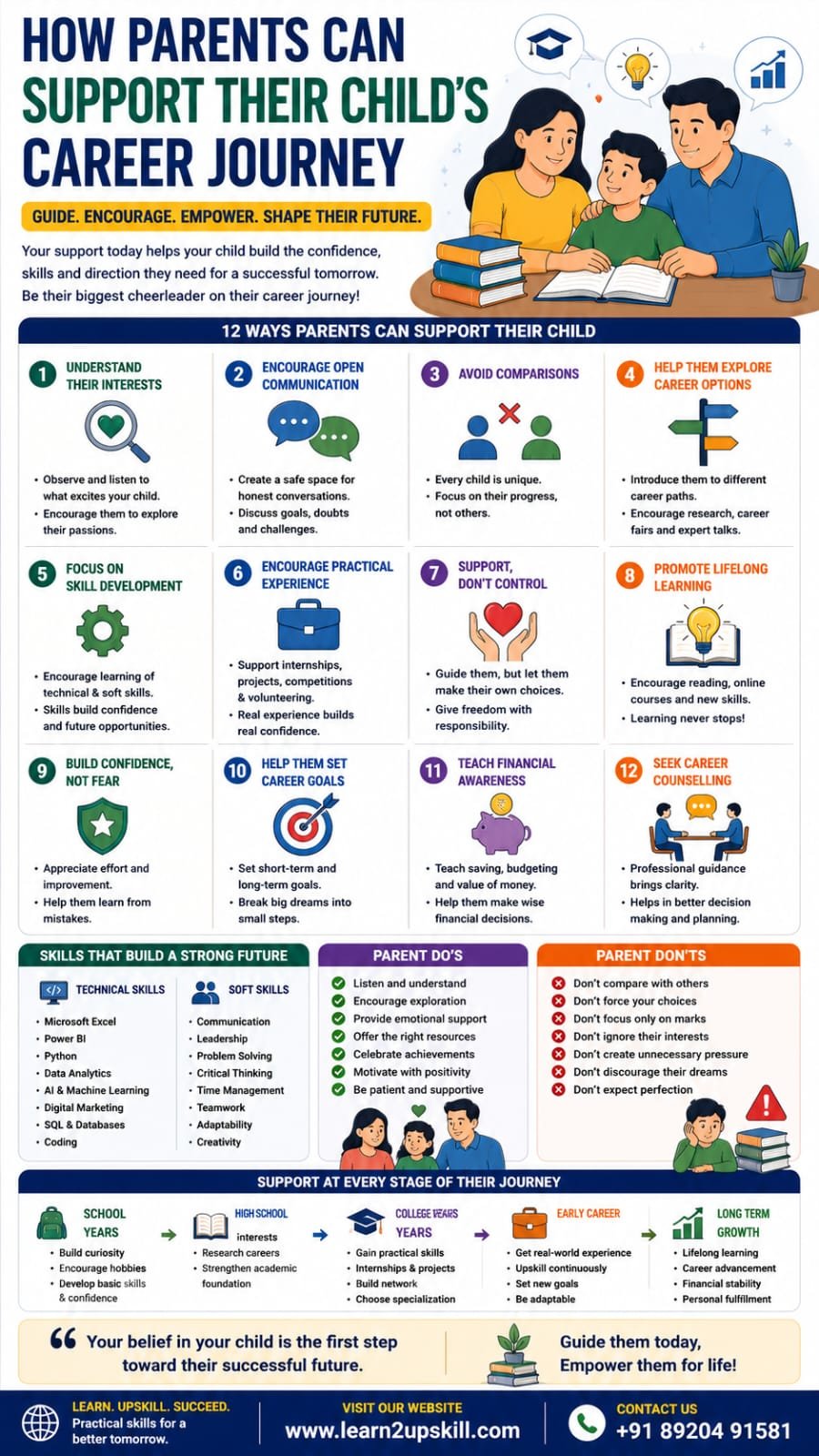
How Parents Can Support Their Child’s Career Journey
How Parents Can Support Their Child’s Career Journey
Learn how parents can support their child’s career journey through guidance, communication, skill development, and informed career planning without creating unnecessary pressure.
Focus Keyword: How Parents Can Support Their Child’s Career Journey
—
How Parents Can Support Their Child’s Career Journey
Every parent wants their child to have a bright, successful, and fulfilling future. However, today’s career landscape is more diverse and dynamic than ever before. Traditional professions are now joined by exciting opportunities in Artificial Intelligence, Data Analytics, Cybersecurity, Digital Marketing, Content Creation, UI/UX Design, Cloud Computing, and many other emerging fields.
With so many choices, students often feel overwhelmed. During this stage, parents play one of the most influential roles in helping children discover their strengths, make informed decisions, and develop confidence in their career path.
Supporting your child’s career journey isn’t about making decisions for them—it’s about empowering them with guidance, encouragement, and opportunities to grow.
This guide explains how parents can effectively support their child’s career development while respecting their individuality.
—
Why Parents Play a Crucial Role
Children often look to their parents for advice, reassurance, and motivation.
Positive parental involvement can help students:
– Build confidence
– Explore career options
– Develop valuable skills
– Make informed decisions
– Handle setbacks positively
– Stay motivated
– Build long-term career goals
When parents become supportive mentors rather than decision-makers, children are more likely to succeed.
—
Step 1: Understand Your Child’s Interests
Every child is unique.
Some enjoy:
– Mathematics
– Science
– Art
– Technology
– Writing
– Sports
– Business
– Design
– Music
– Problem-solving
Observe what naturally excites your child instead of assuming that one career fits everyone.
Ask questions like:
– What subjects do you enjoy the most?
– What activities make you feel excited?
– What kind of problems do you enjoy solving?
– What do you imagine yourself doing in the future?
Listening carefully is the first step toward meaningful guidance.
—
Step 2: Encourage Open Communication
Create an environment where your child feels comfortable discussing:
– Career dreams
– Doubts
– Challenges
– Academic concerns
– Future goals
Avoid judging or dismissing their ideas immediately.
Instead, have regular conversations about possibilities and help them explore options together.
—
Step 3: Avoid Comparing Your Child with Others
Comparison can reduce confidence and increase anxiety.
Avoid statements such as:
– “Your cousin already knows what career to choose.”
– “Your friend scored higher than you.”
Instead, focus on your child’s personal growth and achievements.
Every student’s journey is different.
—
Step 4: Help Them Explore Career Options
Many students only know about a few traditional careers.
Introduce them to emerging fields such as:
Technology
– Software Development
– Data Analytics
– Artificial Intelligence
– Cybersecurity
– Cloud Computing
Business
– Marketing
– Human Resources
– Business Analysis
– Entrepreneurship
Creative Careers
– Graphic Design
– UI/UX Design
– Video Editing
– Animation
– Content Creation
Healthcare
– Medicine
– Nursing
– Physiotherapy
– Medical Technology
Encourage research, webinars, workshops, career fairs, and informational interviews.
—
Step 5: Focus on Skill Development
Today’s employers value practical skills as much as academic qualifications.
Encourage your child to learn:
Technical Skills
– Microsoft Excel
– Power BI
– Python
– SQL
– Artificial Intelligence (AI)
– Digital Marketing
– Coding
– Data Analytics
Soft Skills
– Communication
– Leadership
– Teamwork
– Time Management
– Problem Solving
– Critical Thinking
– Adaptability
Practical skills improve confidence and employability.
—
Step 6: Encourage Practical Experience
Learning extends beyond the classroom.
Help your child gain experience through:
– Internships
– Volunteer work
– Personal projects
– Competitions
– Freelancing
– Workshops
– Online certifications
Real-world experience helps students understand what they enjoy and build stronger resumes.
—
Step 7: Support Without Controlling
Guidance is helpful.
Control is not.
Instead of saying:
“You must become an engineer.”
Try:
“Let’s explore different careers together and see what matches your interests and strengths.”
Children perform better when they feel ownership over their decisions.
—
Step 8: Teach the Importance of Lifelong Learning
The job market changes rapidly.
Help your child understand that learning doesn’t stop after school or college.
Encourage:
– Reading books
– Taking online courses
– Learning new software
– Following industry trends
– Building new skills regularly
Continuous learning prepares students for future opportunities.
—
Step 9: Build Confidence, Not Fear
Fear-based motivation may produce short-term results but can reduce long-term confidence.
Instead:
– Celebrate effort.
– Appreciate improvement.
– Encourage resilience.
– Treat mistakes as learning opportunities.
Confidence grows when children feel supported.
—
Step 10: Help Them Set Career Goals
Teach your child how to set achievable goals.
Short-Term Goals
– Complete an Excel course.
– Improve communication skills.
– Participate in a competition.
Medium-Term Goals
– Complete an internship.
– Build a portfolio.
– Earn certifications.
Long-Term Goals
– Secure a job in a chosen field.
– Pursue higher education.
– Start a business.
Breaking large ambitions into smaller goals makes progress more manageable.
—
Step 11: Teach Financial Awareness
Introduce basic concepts such as:
– Budgeting
– Saving
– Scholarships
– Education expenses
– Career investment
Financial literacy helps students make informed decisions about education and career planning.
—
Step 12: Seek Career Counselling When Needed
Professional career counselling can help students:
– Identify strengths
– Explore suitable careers
– Understand aptitude
– Set realistic goals
– Develop career roadmaps
Counselling complements parental guidance and offers objective insights.
—
Common Mistakes Parents Should Avoid
Avoid:
– Choosing a career on behalf of your child.
– Comparing them with others.
– Focusing only on marks.
– Ignoring their interests.
– Discouraging new career options.
– Expecting perfection.
– Dismissing creative or unconventional careers without proper research.
—
Final Thoughts
A successful career begins with encouragement, exploration, and continuous learning. As a parent, your role is not to choose your child’s future but to help them discover it with confidence.
By listening, encouraging skill development, exposing them to different career opportunities, and supporting informed decision-making, you can help your child build a fulfilling and successful career.
Remember, every child has a unique path. With patience, guidance, and the right opportunities, they can achieve their goals and adapt to the ever-changing world of work.
At Learn2Upskill, we are dedicated to helping students and parents navigate career decisions through expert guidance and practical training in Microsoft Excel, Data Analytics, Power BI, Python, Artificial Intelligence, Digital Marketing, and other industry-relevant skills.
Why Choose Learn2Upskill?
– Personalized career guidance
– Practical, job-oriented training
– Industry-expert mentors
– Hands-on projects
– Skill-based learning
– Career-focused programs
Visit: www.learn2upskill.com
Contact Us: +91 89204 91581
Support Their Dreams Today. Shape Their Success Tomorrow.
You May Also Like
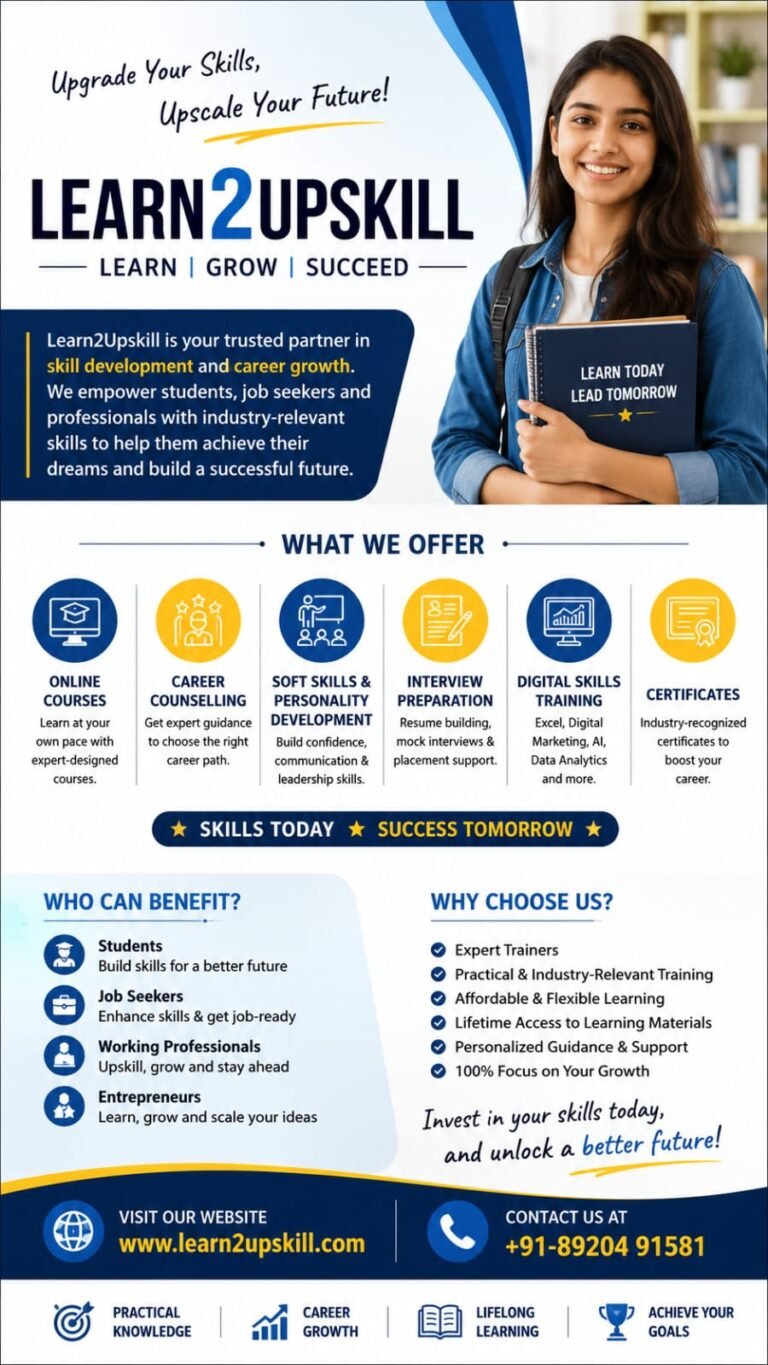
The Complete Guide to Building Confidence and Success Introduction In today’s competitive world, academic knowledge alone is not enough to...
-
-
July 31, 2026
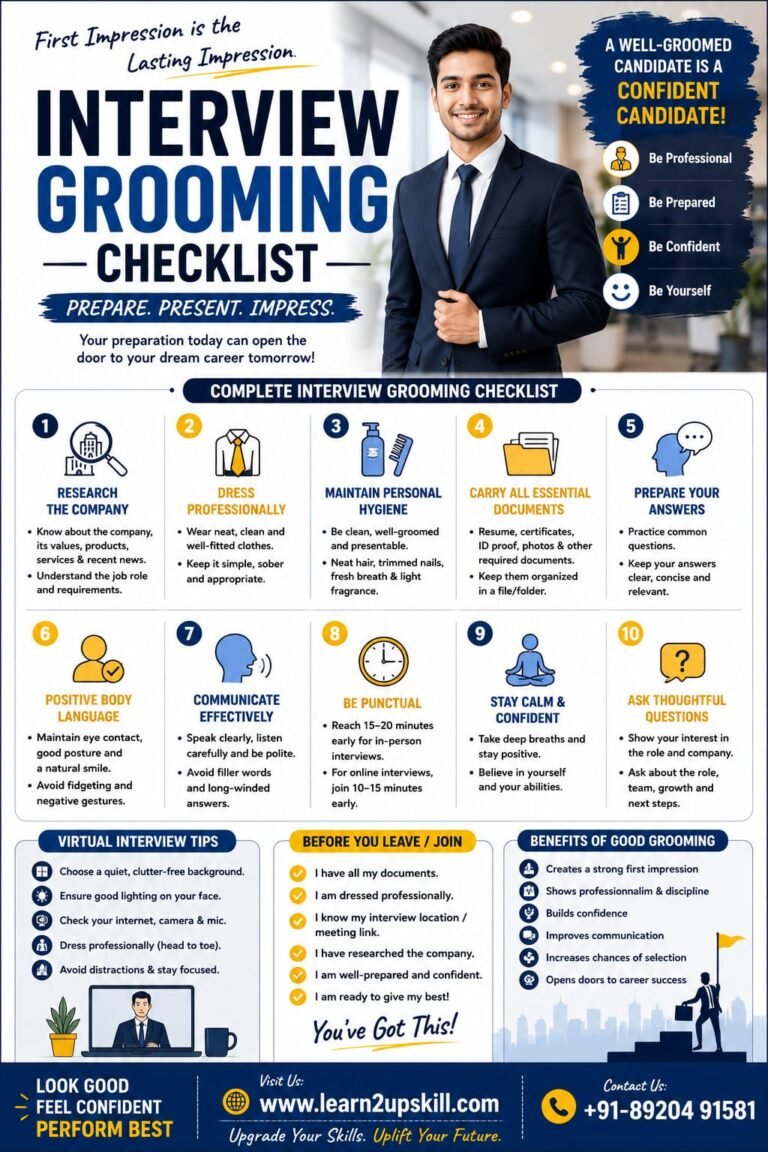
Interview Grooming Checklist Introduction Your interview begins long before you answer the first question. From the moment you enter the...
-
-
July 31, 2026
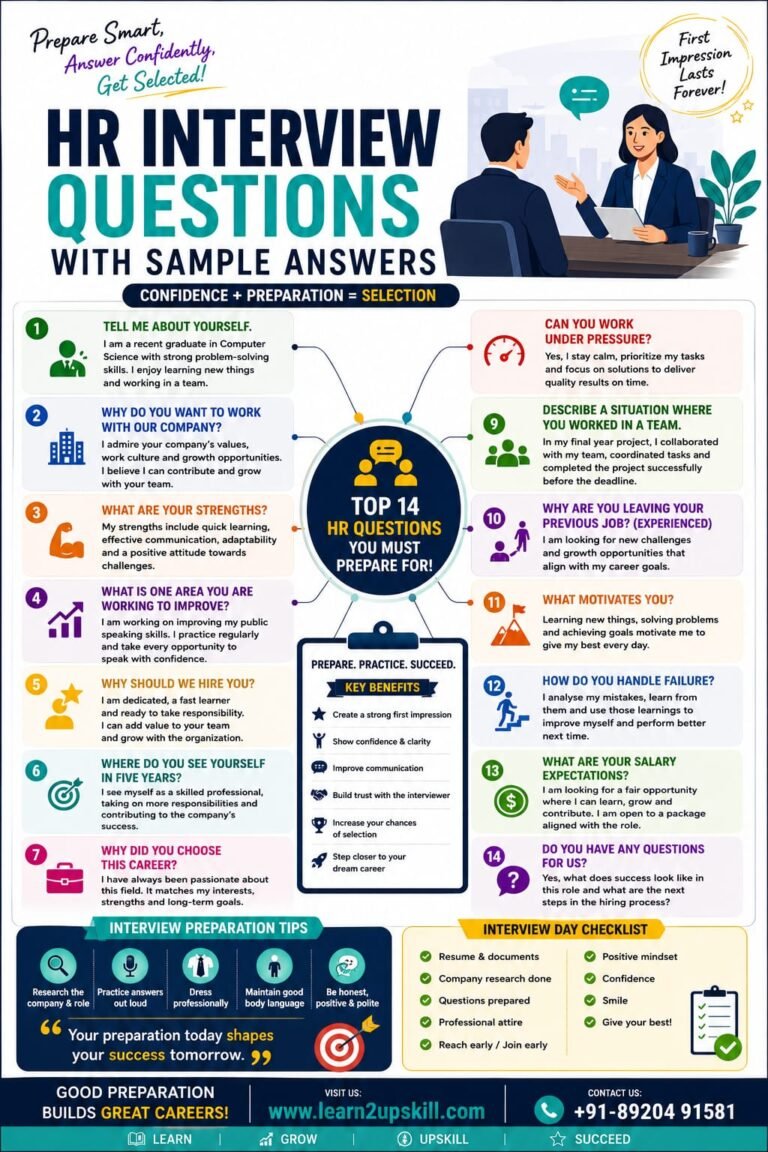
Top HR Interview Questions with Sample Answers Introduction An HR interview is often the final step in the hiring process...
-
-
July 30, 2026